
Rings are seen from above and rarely move. Earrings swing, catch the light and frame your face. That changes which diamond shape works best.
Table of Contents
The short answer: for drop earrings, pear and marquise are the usual favourites because their points lengthen the line of the earring. Asscher gives a calm, geometric, vintage look, while oval and round bring the most all-round sparkle. The best diamond shape for earrings is the one that suits your face shape, your earring style and the way you like to move.
Picture yourself at a mirror with two pairs held up to your ears. On paper both are lovely. Worn, one makes you look polished and the other somehow does not. Shape is usually the reason.
If you are searching for the best diamond shape for earrings and feel unsure where to start, this guide is for you. We explain how earrings differ from rings, walk through each popular shape, and show how to match a shape to your face and your style. A comparison table and a checklist for buying a matched pair finish the guide.
Why the best diamond shape for earrings is not the same as for rings
Most diamond advice is written for engagement rings, and it does not transfer neatly. Earrings live by different rules, and four of them matter.
- They move. A ring sits still on your hand. An earring swings with every turn of your head, so a shape that flashes well in motion earns its place.
- They frame your face. A ring is seen on the hand; an earring is seen next to your eyes, jaw and neck. The outline of the stone changes how your face looks.
- They come as a pair. Two stones have to read as one set. Small differences you would never notice in a single ring become obvious side by side.
- They are lighter. Weight pulls on the earlobe, so the shape and size need to be comfortable for hours, not just beautiful for a photograph.
Keep these four in mind as you read. They explain why a shape that is ordinary on a hand can be wonderful on an ear.
Six shapes, as drop earrings
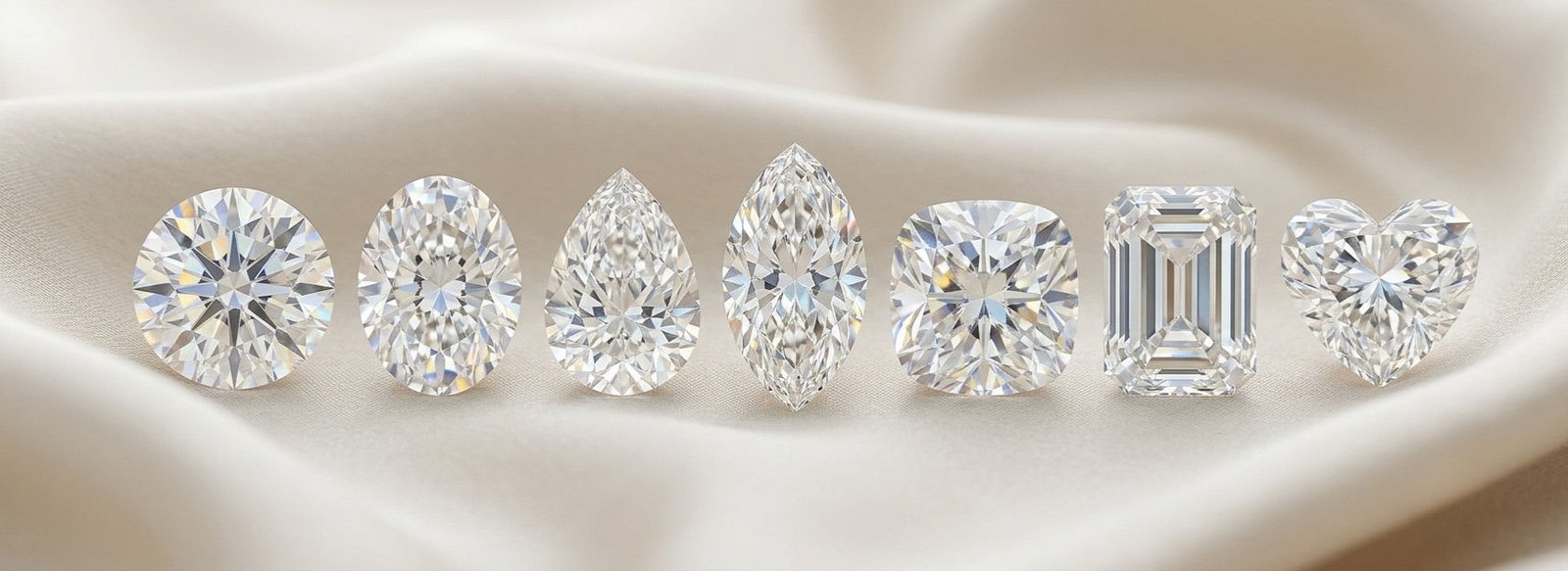
The outline you choose sets the whole mood of the pair. Here they are side by side.
The most popular diamond shapes for earrings
Pear: the classic drop
Round at the bottom and pointed at the top, the pear is the shape most people picture when they imagine pear drop earrings. Worn with the point upward, it hangs like a teardrop and draws the eye down the neck. That vertical line is why it is a favourite for brides wearing their hair up.
Pears are brilliant cuts, so they sparkle well. They can also show a dark shadow across the middle called a bow-tie, and a good pair has a faint one in both stones. The pointed end is the most delicate part, so ask for a V-shaped prong or bezel to protect it.
Watch for: a strong bow-tie, and an unprotected tip.
Marquise: long, slender and dramatic
The marquise is a long, narrow boat with a point at each end. Marquise earrings are the most lengthening choice on this list, and because the stone spreads across a long, thin outline, it can look larger face-up than a round diamond of the same weight.
Worn vertically, marquise earrings give a sleek, modern line. Worn sideways, in a style often called navette, they feel more unexpected. Like the pear, the marquise is a brilliant cut with a possible bow-tie, and its two tips both need protection.
Watch for: two delicate tips, and a bow-tie that differs between the pair.
Asscher: geometric and vintage
The Asscher cut was created in 1902 by Joseph Asscher of Amsterdam. It is a square step cut with deeply cropped corners, which gives it an almost octagonal outline. Instead of sparkling like a brilliant cut, it flashes in long, calm planes, often described as a hall of mirrors.
Asscher earrings suit people who like a clean, architectural look, and the squared shape adds definition to softer faces. The open table also shows more of the stone’s inside, so clarity and colour matter more. Many jewellers suggest VS2 clarity or better and G colour or better for an eye-clean look.
Watch for: visible inclusions and body colour. Choose higher grades than you would for a brilliant cut.
Oval: flattering and versatile
Oval is the easy choice. Its elongated outline looks larger than a round of the same weight, and its brightness is similar to a round brilliant. It sits comfortably in studs, small drops and halo designs, and its soft curves suit almost any face.
It can show a bow-tie, so look at the stones in video before you buy, as with the pear and marquise.
Watch for: a heavy bow-tie, and ovals that are too narrow or too wide for the look you want.
Round: the brightest choice
A round brilliant is cut to return as much light as possible, and it shows. Round diamond studs are the most worn diamond earrings for a reason: they suit every face, every outfit and every occasion, and they have no bow-tie to worry about.
The trade-off is that a round has no length. If you want an earring that lengthens the face, choose a drop in another shape.
Watch for: nothing much. It is the lowest-risk shape, and the least dramatic.
Emerald: sleek and understated
Emerald is the Asscher’s longer, slimmer cousin. It is a rectangular step cut, so it has the same calm flash and the same need for good clarity, but its length makes a quiet, elegant drop. It is a good middle path between the drama of a marquise and the structure of an Asscher.
The best diamond shape for earrings, by face shape
A simple idea guides most advice here: contrast balances a face, and echoing emphasises it. Angular shapes soften round features, curved shapes soften angular ones, and long drops lengthen a short face. Treat what follows as a guide for starting your search, not a set of rules.
Oval face
Balanced proportions, so almost anything works.
Try: pear, Asscher, oval
Round face
Add length and a little structure.
Try: pear, marquise, emerald
Square face
Soften a strong jaw with curves.
Try: pear, oval, round
Heart face
Add weight near a narrower chin.
Try: pear, round, oval
Long face
Add width and avoid very long drops.
Try: round, oval, short pear
If you are between two face shapes, go by how you feel. The shape you reach for is usually the right one.
The best diamond shape for earrings, by earring style
The setting matters as much as the stone. This is how the shapes behave in the most popular styles.
Studs
Round, oval and Asscher. They sit close to the ear, so brilliance and clean lines matter most.
Classic drops
Pear, marquise and oval. A single stone hanging from a short bar or hook gives the most polished look.
Long dangles and chandeliers
Pear, marquise and emerald, in a graduated line. The points keep the eye moving downward.
Huggies and small hoops
Round or small oval stones. Keep the shape simple so the hoop leads.
Diamond shapes for earrings, compared
Use this table to narrow your shortlist before you look at individual pairs.
| Shape | Visual effect | Best earring style | Faces it flatters | Watch for |
|---|---|---|---|---|
| Pear | Lengthening, soft, romantic | Classic drops, dangles | Round, square, heart | Bow-tie, delicate tip |
| Marquise | Most lengthening, modern | Vertical drops, climbers | Round, square | Two tips, bow-tie |
| Asscher | Structured, vintage flash | Studs, small drops | Round, oval | Shows clarity and colour |
| Oval | Gently elongating, flattering | Studs, drops, halos | Most faces | Bow-tie |
| Round | Maximum sparkle, classic | Studs, huggies | Any face | No length |
| Emerald | Sleek, calm, elongating | Clean drops | Round | Shows clarity and colour |
How to choose a matched pair of diamonds
With earrings, the best diamond shape for earrings is only half the decision. The other half is making sure the two stones look like they belong together. A good pair should be close on each of these:
- Length-to-width ratio. Two pears with different proportions look odd side by side, even when the weights match.
- Weight. Each stone should be close to the other, because a noticeable difference shows once they are worn.
- Colour and clarity. Aim for the same grades, and for step cuts such as Asscher, go higher on both.
- Cut quality. For fancy shapes, check the polish and symmetry ratings on the GIA report, where Excellent or Very Good indicates a well-made stone.
- The bow-tie. In pears, marquises and ovals, the shadow should look similar in both stones.
The simplest test is to view the two stones together, in motion, in daylight. If you cannot tell them apart at arm’s length, you have a good pair. Our guide to how we select matching diamond pairs explains how we make that comparison for you.
Three buyers, three choices
To see how this works in practice, here are three imagined buyers and the shapes they might choose.
The bride with an updo
She is wearing her hair up, so her ears and neck will be on show. She chooses pear drops, whose point lengthens the neckline and echoes the shape of her veil.
The professional who wears them daily
She wants something that works from desk to dinner and never snags. She chooses oval studs, which look larger than their weight and suit every outfit.
The anniversary gift
He wants something she will not already own. He chooses marquise drops, a bolder shape that feels like a statement without being fussy.
How we match a pair
See how we compare length, weight, colour and cut so both stones look like one set.
Ready to choose?
Browse matched pairs picked for drop earrings, in every shape in this guide.
Frequently asked questions
What is the best diamond shape for earrings?
For drop earrings, pear and marquise are the most popular because their points lengthen the earring. For studs, round and oval give the most all-round sparkle, and Asscher gives a geometric, vintage look. The right choice depends on your face shape and earring style.
Which diamond shape makes earrings look biggest?
Elongated shapes such as marquise, pear and oval tend to look larger face-up than a round diamond of the same weight, because their length spreads the stone across more of the earring.
Are pear drop earrings good for everyday wear?
Yes, in a secure setting. The pointed tip is the most delicate part of a pear diamond, so ask for a V-shaped prong or a bezel to protect it.
Do Asscher earrings need a higher clarity grade?
Usually, yes. The Asscher is a step cut with a large open table, so inclusions and body colour are easier to see than in a brilliant cut. Many jewellers suggest VS2 clarity or better and G colour or better for an eye-clean look.
Do both diamonds in a pair have to be identical?
They will never be identical, but a good pair is very close in length-to-width ratio, weight, colour, clarity and cut quality, and looks the same when worn.
Which diamond shape suits a round face?
Elongated drops such as pear, marquise and emerald add a vertical line that lengthens a round face. An angular Asscher can also add definition. These are styling guidelines, not rules.
About this guide
Written by the Your Brand Name gemmology team, which selects and matches diamond pairs for earrings. Face-shape advice is general styling guidance. Facts about cuts come from the sources below.
Sources: GIA, Purchasing Fancy Shaped Diamonds and MOH London, Asscher diamond shape guide.
Find the pair that moves with you
Browse matched diamond pairs for drop earrings, each chosen so both stones look like one set.