
◆ MEN’S DIAMOND JEWELLERY
Two small stones decide how a cuff looks. Here is how to compare white, black and salt and pepper diamonds, check that a pair truly matches, and set a budget before you enquire.
Table of Contents
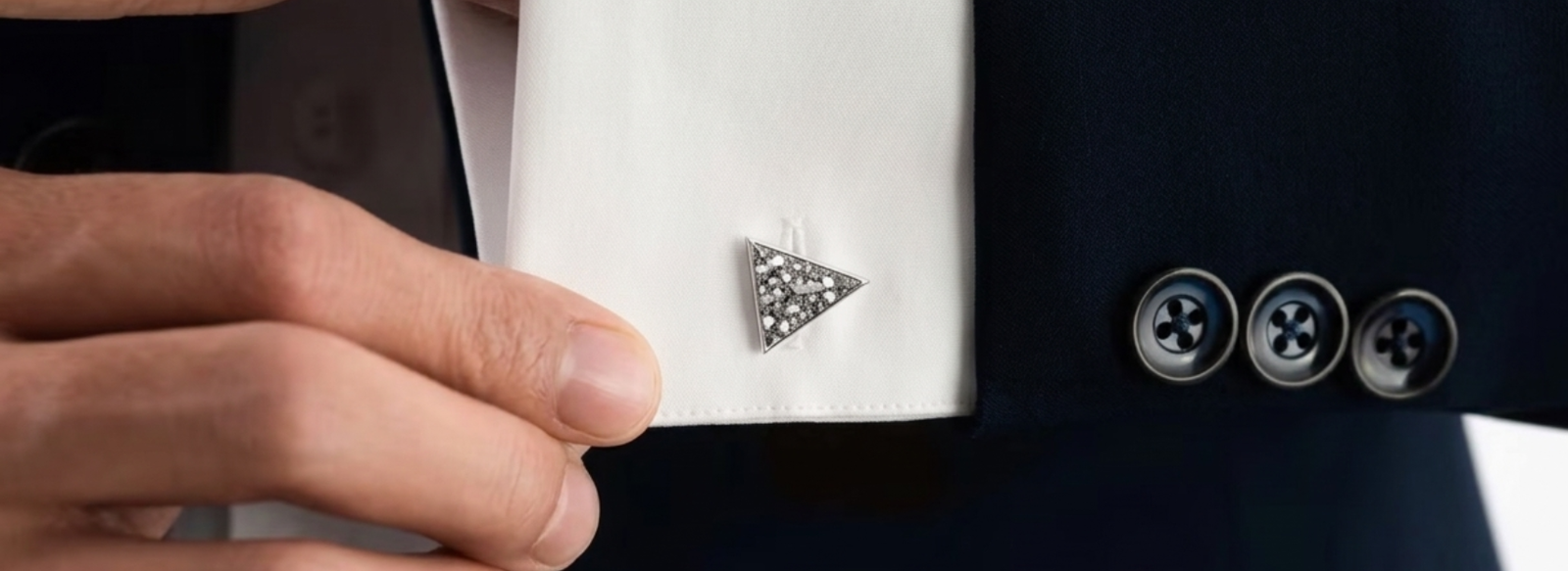
Diamond cufflinks are the one piece of men’s diamond jewellery that sits right at the cuff, where it catches the light every time you reach for a pen or lift a glass. Pick well and a pair of small stones does more for a French cuff shirt than a watch strap or a tie bar. Pick badly and you end up with two stones that do not match, set so loosely they scratch every desk you lean on.
The short answer: for most men, a matched pair of round brilliant diamonds in a bezel setting is the safest choice. If you want something bolder, black diamond cufflinks give a darker, sharper look that works with a tuxedo as easily as a charcoal suit. The rest of this guide shows how to compare stone types, check that two stones really match, and set a budget before you enquire.
Diamond cufflinks at a glance
- Best all-rounder: Matched round brilliants in a bezel
- Bolder look: Black or salt and pepper stones
- Typical size: 0.20 to 1.00 ct total for the pair
- Most protective: Bezel or flush setting
- Made to order: Enquire about a custom pair
Why Diamond Cufflinks Are Chosen Differently From Rings
A ring has one stone and one finger. A pair of cufflinks has two stones that sit a few centimetres apart, so any difference between them shows. That is the first rule of buying diamond cufflinks: you are not buying a diamond, you are buying a pair.
Two Stones, One Look
A matched pair means both stones share the same diameter, colour, clarity and cut proportions closely enough that nobody can tell them apart at arm’s length. Two stones with the same carat weight can still look different if one is cut deeper and measures smaller across the top. A jeweller who matches stones by eye under the same light, not by certificate alone, gives you a better pair.
Cuffs Take Knocks
Diamond is the hardest natural material, but hard is not the same as tough. A sharp knock on the corner of a desk can chip a stone, and cuffs get knocked all day. For diamond cufflinks, a protective setting matters more than the last point of sparkle.
Pairing Cufflinks With Other Men’s Diamond Jewellery
If you already wear men’s diamond jewellery, such as a ring, a bracelet or a pendant, let one piece lead. Diamond cufflinks that echo the metal of your watch case look intentional, while stones of very different colours can fight each other. Our short guide to matched diamond pairs shows how to keep a whole set consistent.
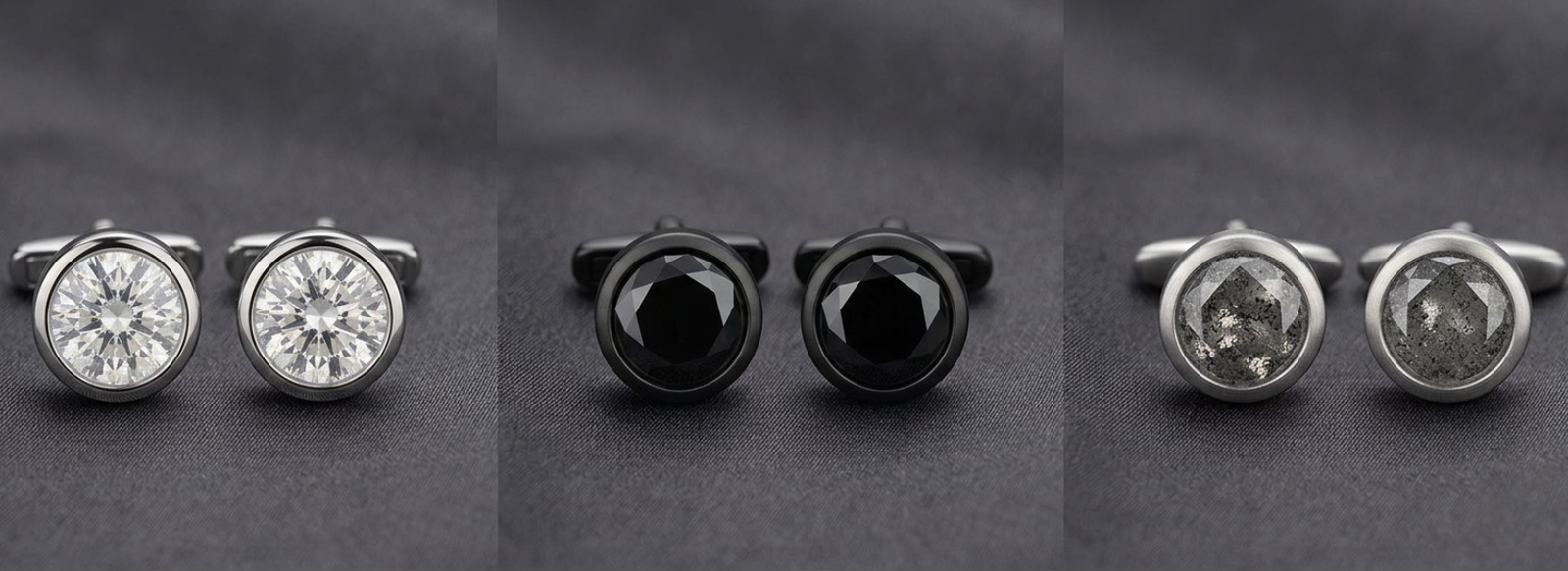
White, Black or Salt and Pepper: Which Diamond Suits Your Cufflinks?
White Diamond
Black Diamond
Salt and Pepper
There is no single best stone. The right choice depends on what you wear and how loud you want the cufflinks to be. This table compares the three most common options for diamond cufflinks.
Coloured diamonds exist too, but they are rare and costly. If you want a deep blue or a warm champagne tone, treat it as a special commission rather than a first pair.
Black Diamond Cufflinks: When the Dark Stone Is the Right Call
Black diamond cufflinks suit men who find white stones too shiny for the office. From a distance a black stone reads as a polished dark disc, and up close it shows its facets. On a white cuff it gives strong contrast, which is why it works so well with dark formalwear.
Natural or Treated Black Diamonds
Natural black diamonds get their colour from tiny mineral inclusions such as graphite, and they are rarer than colourless or brown stones. According to GIA’s black diamond guide, treated black diamonds are far more common on the market: lower-quality grey or brown stones are heated or irradiated until they turn dark. Treated stones can look excellent and cost less, but you should be told. Ask for written disclosure before you pay.
What to Wear Them With
Black stones suit a tuxedo, a charcoal suit and a navy suit. With a pale grey suit they look sharp but heavy, so pick a smaller stone. For tweed and textured jackets, a salt and pepper stone usually sits better.
To compare real pairs, browse our black diamond cufflinks.
Cufflink Diamonds: Quality and Matching Explained
White Diamond
Black Diamond
Salt & Pepper
Good cufflink diamonds are small, so the usual grading rules apply a little differently. You are judging two stones at about arm’s length, not one stone under a loupe.
How Many Carats Do Cufflinks Need?
Carat weight is usually quoted for the pair, so always ask whether a figure is per stone or in total. This table shows how total weight turns into the size you will actually see.
| Total weight (pair) | Each stone | Face-up width | Suits |
|---|---|---|---|
| 0.20 ct | 0.10 ct | About 3.0 mm | Subtle, everyday wear |
| 0.50 ct | 0.25 ct | About 4.1 mm | Business and weddings |
| 1.00 ct | 0.50 ct | About 5.1 mm | A confident statement |
| 2.00 ct | 1.00 ct | About 6.5 mm | Black tie and special gifts |
Colour, Clarity and Cut for Small Stones
At this size, cut matters most. A well cut stone throws light even from a distance, while a poorly cut one looks flat. Colour and clarity matter less than they do on a ring: mid-range grades usually look clean at arm’s length, though your jeweller should confirm this for the exact stones.
How to Check a Pair Is Matched
Use these five checks, in this order, before you commit to a pair.
1
Measure both stones.
As a rule of thumb, diameters should agree to within about 0.1 mm.
2
Compare them under one light.
Lay them side by side on white paper and look from above.
3
Check the colour.
Tilt both against a white background. Neither should look warmer.
4
Look at the cut.
Depth and table size should look alike face-up.
5
Ask for the paperwork.
Request a report for each stone, or a note from the jeweller confirming the match.
Inside a cufflink
Matched or mismatched
Infographic: the parts of a diamond cufflink, and what a matched pair looks like next to a mismatched one.
Settings and Metals That Protect Your Diamond Cufflinks
Because cufflinks get knocked, the setting is part of the safety plan, not just the look. Three styles cover most diamond cufflinks.
Bezel
A thin metal rim wraps the stone. It is the most protective setting and gives a clean, modern outline.
Pavé
Many tiny stones sit in a metal face. It gives wide sparkle, but more points that can catch and wear.
Flush
The stone sits level with the metal. It is smooth, snag-free and a good match for black diamonds.
Back Types and Metals
The back keeps the cufflink in the cuff. A swivel back is quick to use, a whaleback is flat and secure, and a chain link gives a looser, classic drape. For metal, white gold and platinum keep a white stone looking crisp, yellow gold adds warmth, and sterling silver keeps the price down but marks more easily.
Two small stones, matched well, say more than one large stone chosen carelessly.
How to Set a Budget for Diamond Cufflinks
Cost moves with four things: total carat weight, stone quality, the metal, and whether the pair is made to order. A larger pair in platinum costs far more than a modest pair in sterling silver, even with similar stones.
Where to Spend and Where to Save
Spend on cut and on a secure setting, because those decide how a pair looks and how long it lasts. Save on colour and clarity grades that nobody can see at arm’s length. This is the simplest way to get good diamond cufflinks without paying for detail that disappears on a cuff.
Decide the most you want to spend, then choose the stone size before the metal, because size is what people see. Custom diamond cufflinks cost more than ready-made pairs, but they let you match the stones to your watch, ring or tie bar.
Choosing Diamond Cufflinks as a Gift
Diamond cufflinks are a popular gift for a groom, a groomsman or an anniversary. For a wedding, a pair of white stones in a bezel setting is the safe choice, and a small engraving on the back makes it personal. For a milestone birthday or a promotion, a larger pair or a black diamond pair says more. If you do not know his shirt style, check that he owns French cuff shirts first, since standard cuffs need a different fastening.
Buying for someone else makes matching even more important, because he will wear the pair for years and notice any difference between the two stones.
Care and Storage for Diamond Cufflinks
A little routine keeps diamond cufflinks looking new for years.
Wipe after wearing. A soft cloth removes skin oils.
Store them apart. Keep each pair in its own pouch.
Avoid harsh chemicals. Chlorine and bleach can harm the metal.
Check the setting yearly. Ask a jeweller to test that each stone is secure.
Diamond Cufflinks FAQs
Are diamond cufflinks too formal for daily wear?
No. A small pair, around 0.20 to 0.50 ct in total, in a bezel setting looks smart with a business shirt and is tough enough for daily wear. Save larger stones for black tie.
Are black diamonds real diamonds?
Yes. Black diamonds are real diamonds, either natural or treated. Natural ones are rarer, and treated stones should be disclosed. Ask which one you are buying.
How many carats should diamond cufflinks be?
For most men, 0.20 to 1.00 ct in total for the pair suits business wear and weddings. Remember that the weight usually covers both stones together.
Should I choose natural or lab-grown diamonds?
Both are real diamond and both can be graded. Natural stones are rarer, and lab-grown stones cost less at the same size. Choose on budget and preference, and make sure the seller states which one you are getting.
Can I have a pair made to match my ring or watch?
Yes. A jeweller can match the metal, the stone type and the style, for example a black diamond to echo a watch dial. That is what a custom pair is for.
How do I clean diamond cufflinks?
Soak them in warm water with a drop of mild soap, brush gently with a soft toothbrush, rinse and dry with a soft cloth. Store each pair in its own pouch.
Enquire About Custom Cufflinks
Want a pair made to your stones, metal and budget? Tell us what you wear and we will suggest matched diamond cufflinks.
About the author
[Author name], [credential, e.g. GIA Graduate Gemologist]. [Two sentences on hands-on experience matching stones for cufflinks.]
Reviewed by [Reviewer name], [credential]. Last reviewed 12 October 2026.
How this guide was researched
Facts about black diamond colour and treatment come from GIA’s published buyer guidance. Size figures are typical values for round brilliant diamonds. Matching advice reflects general jewellery practice, not a substitute for seeing a pair in person.
Sources
This guide links to our own collections and guides.
© 2026 [Your Brand Name]. All rights reserved.